

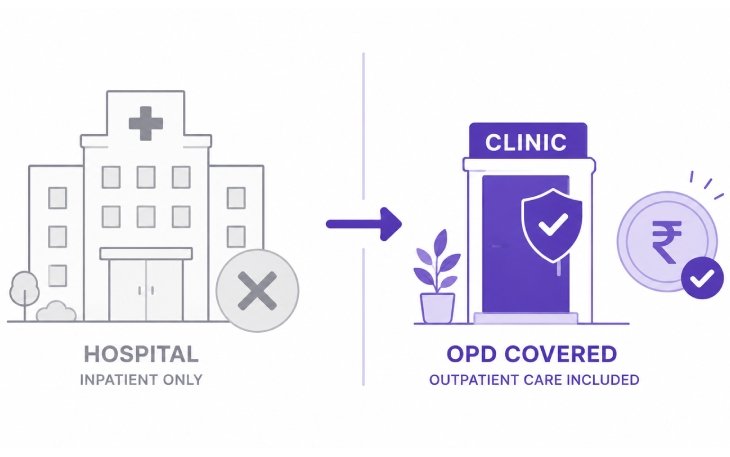
OPD cover is health insurance that pays for medical expenses that don’t require hospitalisation, doctor consultations, diagnostic tests, prescribed medicines, physiotherapy, and more. Standard health insurance does not cover these. Every consultation and prescription is paid out of pocket regardless of how many hospitalisation policies you hold. Whether OPD cover is worth adding depends on your family’s actual outpatient spend.
What OPD Cover Typically Includes
- Outpatient doctor consultations — GP and specialist visits
- Diagnostic tests ordered by a doctor — blood tests, scans, imaging
- Prescribed medicines
- Physiotherapy and rehabilitation
- Dental treatment (in some plans)
- Vision/optical care (in some plans)
- Mental health consultations (increasingly included in 2025–26 plans)
How OPD Limits Work
OPD cover works through an annual limit, typically ₹10,000 to ₹1,00,000 per year depending on the plan. You submit bills up to this limit for reimbursement, or access cashless facilities at network centres where available. Cashless OPD is available in a small number of premium plans in 2026 and is significantly more practical than reimbursement for smaller amounts.
The Calculation: Is It Worth Buying?
An OPD rider or OPD-inclusive plan typically adds ₹3,000–8,000 to annual premium for a family. Estimate your typical annual outpatient spend: specialist consultations (₹600–1,500 each, 2–4 times per year), diagnostics (₹2,000–5,000), medicines (₹3,000–12,000 depending on chronic conditions). If total OPD spend exceeds the premium addition, the cover pays for itself.
For families managing chronic conditions — diabetes, hypertension, thyroid, asthma — annual OPD spend typically ranges from ₹20,000 to ₹60,000. OPD cover for these families pays for itself multiple times over.
Tax Benefit on OPD Cover Under Section 80D
Premiums paid for health insurance including OPD cover qualify for tax deductions under Section 80D of the Income Tax Act. The deduction limits are: up to ₹25,000 per year for self, spouse, and dependent children (or ₹50,000 if you or your spouse is a senior citizen); up to ₹25,000 additionally for parents below 60, or ₹50,000 if either parent is above 60. Preventive health check-up expenses up to ₹5,000 are included within these limits.
⚠ Important: Section 80D deductions are available ONLY under the old tax regime. If you have opted for the new tax regime, you cannot claim 80D deductions on health insurance premiums.
Draco Insurance compares OPD-inclusive plans and helps you calculate whether the premium addition makes financial sense for your family profile. Visit dracoinsurance.in or call +91 7064106417.
“Even if we do not talk about 5G (specifically), the security talent in general in the country is very sparse at the moment. We need to get more (security) professionals in the system”
Bharti Airtel, for example, has been preparing for 5G roll out by upskilling its professionals and offering them certification courses such as CCNA (Cisco Certified Network Associate) and CCNP (Cisco Certified Network Professional). The courses are offered based on skill and eligibility level free of cost.