

Blog

Co-pay, Deductible, and Sub-limit in Health Insurance: What They Actually Cost You

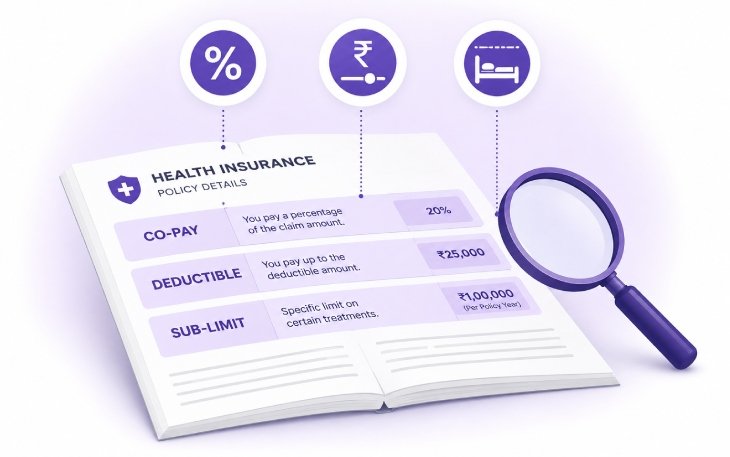
When comparing health insurance in India, most buyers focus on the premium and the sum insured. The clauses that determine how much you actually receive at claim time – co-pay, deductible, and sub-limit often go unread. Understanding these three terms before you buy can save more than any premium comparison ever will. What Co-Pay Means A co-payment is a clause requiring you to bear a fixed percentage of every approved claim. The insurer pays the rest. If your policy has a 10% co-pay and the hospital bill is ₹1,00,000, you pay ₹10,000 and the insurer pays ₹90,000  regardless of your sum insured. Co-pay can be voluntary (chosen by you to reduce premium) or mandatory (imposed by the insurer, typically for senior citizen plans or non-network hospital treatment). The practical risk: on a major illness claim of ₹10 lakh with a 20% co-pay, you pay ₹2 lakh out of pocket even though you are fully insured. Co-pay applies to every claim at the same percentage. The absolute amount you pay scales directly with the bill size making high co-pay especially costly for serious illness claims. What a Deductible Is A deductible is a fixed rupee amount you pay before the insurer covers anything. Most Indian health policies use an aggregate deductible , once you have paid the deductible in a policy year, all subsequent claims are covered in full up to the sum insured. Example: a ₹1 lakh aggregate deductible means you pay the first ₹1 lakh of claims each year. A claim of ₹80,000 is paid entirely by you. A claim of ₹3 lakh means you pay ₹1 lakh and the insurer pays ₹2 lakh. For people with corporate cover, a high-sum-insured individual policy with a deductible matching the corporate cover limit is an efficient and low-cost strategy.
  • Medical inflation in India is running at approximately 14% annually (ACKO Health Insurance Index 2024). Cost-sharing structures chosen now have compounding financial implications over a 20-year policy tenure.
What Sub-Limits Are and Why They Cause the Most Claim Shock
Sub-limit in Health Insurance

A sub-limit caps how much the insurer pays for a specific component of a claim. The most consequential: room rent sub-limits. A policy capping room rent at 1% of sum insured per day allows a ₹5,000/day room on a ₹5 lakh policy. If you stay in an ₹8,000/day room, you pay the ₹3,000 difference  but the impact extends further.

Most policies with room rent caps apply proportionate deduction: doctor fees, surgery, diagnostics, and all associated costs are also reduced proportionately based on the room upgrade percentage. A 60% room cost excess can reduce total claim payout by 35–50%. This is the most common cause of claim shock in Indian health insurance.

ClauseBetter OptionWatch For
Co-payZero co-pay or voluntary onlyMandatory co-pay in senior citizen plans
DeductibleAggregate (optional) if you have corporate coverPer-claim deductible instead of aggregate
Room rent sub-limitNo limit or single private room without cap1% of SI cap triggering proportionate deduction
Illness sub-limitNo disease-specific capsFixed limits for cataract, hernia, knee replacement


Draco Insurance compares policy fine print not just premiums across 15+ insurers to find plans that protect you at claim time. Visit dracoinsurance.in or call +91 7064106417.

Bharti Airtel, for example, has been preparing for 5G roll out by upskilling its professionals and offering them certification courses such as CCNA (Cisco Certified Network Associate) and CCNP (Cisco Certified Network Professional). The courses are offered based on skill and eligibility level free of cost.


Insurance

See More Insurance

Talk to us

Protect What Matters Most

Get personalized insurance coverage tailored to your needs. Share your details and our experts will help you find the perfect protection plan.

Why Choose Us

How It Works

1

Share your details & requirements

2

Get personalized quotes from top insurers

3

Choose your plan & get covered instantly

Get FREE Expert Advice