
Every vehicle on Indian roads must have motor insurance by law but the mandatory requirement is only third party insurance, not comprehensive. Many vehicle owners assume that legally mandatory means adequately protected. It does not. Knowing the difference between third party and comprehensive motor insurance determines whether you are protected only against claims from others, or protected against damage to your own vehicle as well.
What Third Party Motor Insurance Covers
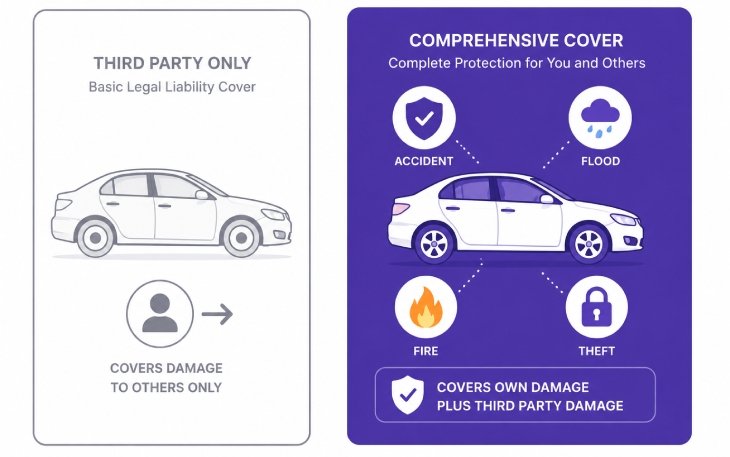
Third party motor insurance covers your legal liability to others if your vehicle causes an accident. It pays for injury or death of a third party, and for damage to third party property. The premium is fixed by IRDAI and is identical across all insurers for the same vehicle class.
What it does not cover: any damage to your own vehicle. A collision that damages your car, a theft, a flood, a fallen tree – none of these are covered under third party only. The insurer pays zero toward your own repair or replacement.
What Comprehensive Insurance Adds
| Coverage | Third Party | Comprehensive |
| Third party injury or death | Yes | Yes |
| Third party property damage | Yes | Yes |
| Own vehicle accident damage | No | Yes |
| Theft of vehicle | No | Yes |
| Natural disaster damage (flood, earthquake) | No | Yes |
| Fire damage | No | Yes |
| Zero depreciation (as add-on) | No | Available |
| Engine protection (as add-on) | No | Available |
When Third Party Only Makes Sense
Third party only is logical when the vehicle’s current market value is low enough that comprehensive cover is uneconomical. As a general rule: when the annual own-damage premium exceeds 5–8% of the vehicle’s current market value, the cover may not be cost-effective. This typically applies to vehicles more than 10–12 years old with a resale value below ₹1.5–2 lakhs.
For any vehicle with meaningful market value purchased in the last 7–8 years ,comprehensive cover is almost always the correct choice.
Two Add-Ons That Make Comprehensive Significantly More Valuable
Zero depreciation cover eliminates age-based depreciation on replaced parts. Without it, the insurer deducts 25–50% of part costs based on the vehicle’s age. Engine protection cover handles engine and gearbox damage from water ingress or oil leaks, which standard comprehensive policies exclude. In flood-prone Indian cities, engine protection is not optional.
Draco Insurance compares comprehensive motor insurance across 15+ insurers and identifies the add-ons that genuinely matter for your vehicle and location. Visit dracoinsurance.in or call +91 7064106417.
“Even if we do not talk about 5G (specifically), the security talent in general in the country is very sparse at the moment. We need to get more (security) professionals in the system”
Bharti Airtel, for example, has been preparing for 5G roll out by upskilling its professionals and offering them certification courses such as CCNA (Cisco Certified Network Associate) and CCNP (Cisco Certified Network Professional). The courses are offered based on skill and eligibility level free of cost.